
Higher Order Molecular Organisation as a Source of Biological Function
Thomas Gaudelet, Noël Malod-Dognin and Nataša Pržulj
Corresponding author: Prof. N. Pržulj, natasa.przulj@mbzuai.ac.ae
Downloads
Hypergraphlets counter
To compile, set the path to your local Boost installation in the Makefile, then run:
make
To run:
./run_hypercounter -g <hyperedge list> -o <output name> -t <threads> -b <blocks>
-
-t: number of threads (OpenMP), default 1 -
-b: number of vertex blocks distributed across the threads, default 50. Vertices are assigned to blocks at random, so densely connected vertices don’t end up in the same block.
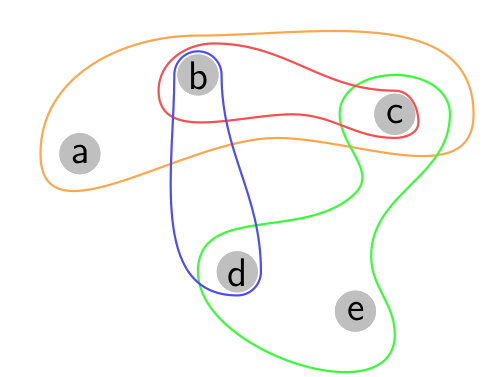
Input: tab-separated hyperedge list. Each row starts with the hyperedge index (0 to m-1), followed by the vertices it contains (indexed 0 to n-1).
Output: .svml file with one row per vertex. The first and last numbers are the vertex index; in between are the orbit counts as orbit:count.
Citation
T. Gaudelet, N. Malod-Dognin and N. Pržulj. Higher-order molecular organization as a source of biological function. Bioinformatics 34(17), i944–i953 (2018). https://doi.org/10.1093/bioinformatics/bty570